

When you think about getting an X-ray taken, what pops into your mind first? The thick lead door of the hospital radiology department, or the bulky machine that takes up half a room? Today, a device known as handheld DR is quietly reshaping this landscape. Compact enough to be held in one hand and lightweight enough to slip into a backpack, it captures high-definition digital radiographic images in mere seconds. Let us dive deep into this pocket-sized radiology solution.
What Exactly Is Handheld DR?
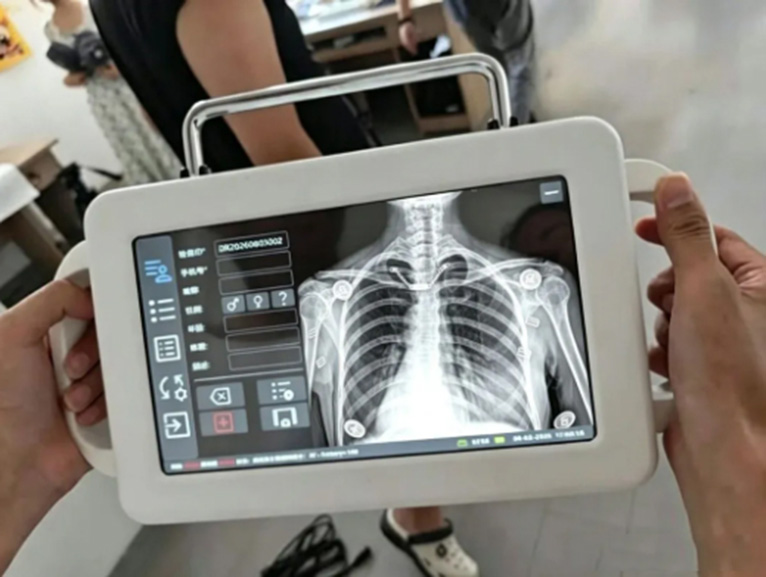
Handheld DR is the shortened term for Handheld Digital Radiography System, which can be simply understood as a portable X-ray camera you can carry anywhere.
Conventional full-size DR units are massive and immovable, requiring dedicated lead-lined radiographic rooms with costly renovation and maintenance expenses. By integrating three core components: miniaturized high-frequency inverter high-voltage generator, compact X-ray tube, and wireless flat-panel detector, handheld DR achieves remarkable lightweight optimization.
How portable is it? Most handheld DR devices available on the market weigh between 3 to 5 kilograms. Certain models resemble oversized digital cameras and weigh only 2.7 kilograms; others clock in at 3.5 kilograms, easy to grip with a single hand. Equipped with built-in lithium batteries, they support continuous radiographic work without external power supply.
Four Core Advantages of Handheld DR
Ultimate Portability Breaking Geographical Barriers
Traditional X-ray examinations are confined exclusively to radiology departments. Handheld DR can be deployed wherever medical needs arise: hospital wards, emergency rescue sites, disaster zones, rural communities, and even patients’ private residences. No dedicated radiographic room is required; corridors, ward spaces, ambulances and open fields all serve as viable examination sites. Some units can be unpacked, assembled and ready for use within 5 minutes, enabling instant on-demand radiographic services.
Rapid Imaging Optimizing Clinical Efficiency
Conventional film-based X-rays demand lengthy developing and waiting time. Adopting direct digital radiography technology, handheld DR generates crisp digital images instantly right after exposure, with imaging time ranging from 3 to 10 seconds. Clinical data verifies that handheld DR drastically cuts the duration of a single radiographic check compared with traditional workflows. In emergency wards and ICUs, this instant preview capability is critical to saving critically ill patients.
Lower Radiation Dosage Enhanced Safety Profile
Handheld DR applies automatic exposure control, which adjusts radiation output dynamically according to the patient’s body size. The radiation dose delivered by a single scan is an order of magnitude lower than that of traditional X-ray equipment. The radiation exposure from one chest radiograph equals just a few days of natural background radiation people are normally exposed to daily. The device also supports remote wireless exposure control, allowing operators to conduct scans from a safe distance away from radiation.
Digital Archive and Seamless Interconnection
Digital images captured by handheld DR can be transmitted in real time to hospital PACS systems via Wi-Fi or 5G networks. Physicians can access and interpret scans remotely, while AI-assisted diagnosis tools automatically flag lesions such as fractures and pulmonary infections. This lays a solid technical foundation for tiered healthcare delivery and cross-regional telemedicine consultations.
Main Application Scenarios of Handheld DR
Emergency Departments & ICUs
Critically ill patients cannot be transported safely for radiology tests. Handheld DR delivers bedside scans directly, eliminating the risks associated with patient transfer. Top-tier hospitals utilize portable DR in ICUs to complete over 50 bedside radiographic examinations daily.
Orthopedics & Trauma Care
Fractures and joint dislocations call for swift assessment of injuries. Thanks to its quick deployment and flexible operation, handheld DR completes on-site imaging rapidly during emergency rescues. It also enables intraoperative real-time verification of internal fixation placement and joint replacement outcomes.
Primary Healthcare & Public Health Physical Examinations
Township clinics and remote villages are often deprived of large-scale radiographic equipment, yet handheld DR makes X-ray services accessible to underserved populations. During community-wide public health screenings, medical staff can bring the device straight to the homes of homebound elderly and finish examinations beside their beds.
Disaster Relief & Field Military Medicine
In harsh post-disaster environments following earthquakes or floods, handheld DR boasts light weight, easy transportation and battery-powered operation, facilitating the quick setup of temporary imaging stations. Clinical trials confirm that portable DR delivers nearly identical diagnostic accuracy for fractures as fixed mobile DR systems in field combat medical settings.
Veterinary Medicine
Demand for animal X-ray checks has surged dramatically in recent years. The compact size and flexible operation of handheld DR perfectly fit the operational needs of veterinary clinics.
Market Outlook A Booming Blue Ocean Industry
The global handheld DR market is undergoing robust expansion. Statistics show the market was valued at approximately 62.5 million US dollars in 2025, projected to reach 181 million US dollars by 2032, representing a compound annual growth rate of 16.6%. In China, the domestic portable DR market exceeded 3.2 billion RMB in 2025, with an annual growth rate surpassing 18%.
Leading global manufacturers include Fujifilm, Delft Imaging, MIKASA, Shantou Ultrasonic Equipment, OXOS Medical and more. In terms of technological evolution, cutting-edge innovations such as photon-counting detectors, AI-powered diagnostic algorithms and 5G-enabled remote consultation are being rapidly incorporated into handheld DR devices.
Closing Thoughts
From room-occupying bulky machinery to backpack-portable compact gadgets, the evolution of handheld DR embodies the people-centered philosophy of modern medical technology. It has freed diagnostic imaging from the boundaries of radiology departments, bringing services closer to patients: severely ill elderly patients confined to ICU beds, villagers queuing up for physical examinations in remote mountain areas, and survivors waiting for medical aid amid disaster rubble.
Stowing a full radiology department into your pocket and making quality healthcare within reach — this is the transformative power of handheld DR.
Post time: Aug-11-2026