

Within hospitals, when critically ill patients cannot travel to the radiology department for radiography, a special mobile medical team will be dispatched, equipped with peripatetic portable DR. Hailed as a radiology department on wheels, it is quietly revolutionizing the workflow of conventional medical imaging.
1. What is Portable DR?
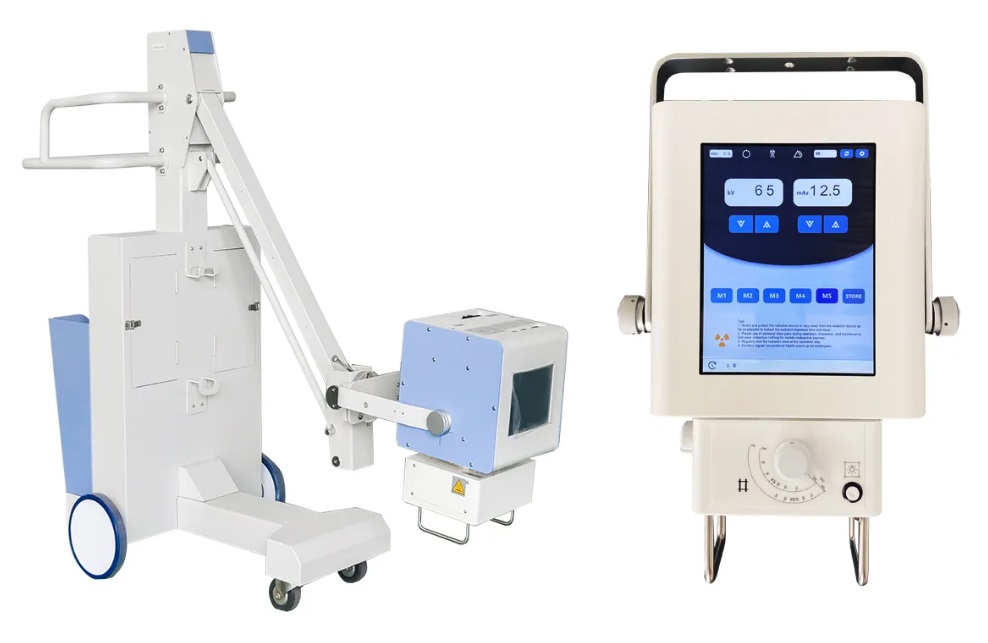
Portable DR is the abbreviation of Portable Digital Radiography System. Simply put, it is a transportable X-ray machine.
Its operating principle is straightforward. A high-voltage generator supplies high voltage to the X-ray tube, accelerating electrons emitted from the cathode filament inside a vacuum tube. The high-speed electrons strike the anode target and generate X-rays. After penetrating human tissues, X-rays attenuate to varying degrees according to tissue density. A digital flat-panel detector captures the attenuated rays and converts them into digital signals, which are processed to generate clear radiographic images of internal anatomical structures on a computer.
Compared with stationary full-size DR systems, portable DR removes rigid restrictions such as dedicated lead-lined shielding rooms and fixed installation positions. Integrated with compact high-frequency high-voltage generators, mini X-ray tubes, wireless flat-panel detectors and mobile workstations, it enables the equipment to travel directly to patients.
2. Application Scenarios of Portable DR
Bedside Examination in Hospitals
This is the most classic application of portable DR. In ICUs, emergency departments and operating rooms, critically ill patients are unable to be transferred. Portable DR can be moved directly beside hospital beds to complete radiographic examinations covering the head, chest, abdomen, limbs and other body regions. Research indicates that bedside radiography with portable DR delivers remarkable advantages in convenience and efficiency compared with traditional workflows.
Emergency Treatment and Intensive Care
For patients with multiple trauma or respiratory failure, portable DR facilitates rapid bedside diagnosis of fractures, pneumothorax, pulmonary infection and other acute conditions. Patient transportation is avoided, eliminating risks including dislodged endotracheal intubation and interference from connected life-support equipment.
Primary Healthcare Services
Portable DR addresses the shortage of imaging equipment at grassroots medical institutions. Township health centers and community clinics can deploy the system for routine radiography and chronic disease screening. Combined with vehicle-mounted mobile medical services, medical staff can carry portable DR to remote villages and deliver on-site radiography services for homebound elderly patients.
Emergency Rescue and Field Military Medicine
In the aftermath of earthquakes, floods and other natural disasters, portable DR can be rapidly deployed to areas with damaged infrastructure or limited power supply. Field medical teams utilize the equipment to quickly identify fractures, thoracic and abdominal injuries among casualties. Its outstanding mobility and environmental adaptability satisfy the rapid setup and rapid evacuation requirements of field medical support.
3. Market Outlook: A Fast-Growing Blue Ocean
Portable DR has emerged as a high-growth segment within the medical imaging equipment industry.
Domestic China Market
The market scale of portable DR in China exceeded 3.2 billion RMB in 2025, with an annual growth rate above 18%. In Q1 2025, 904 DR-related devices including stationary DR, mobile DR and portable DR were procured nationwide, with a total transaction value of approximately 1.05 billion RMB.
Global Market
The global mobile DR market size is estimated to reach USD 10.779 billion in 2025 and USD 19.704 billion by 2032. The handheld DR market is projected to expand from around USD 62.5 million in 2025 to USD 181 million by 2032.
Domestic Chinese manufacturers demonstrate outstanding competitiveness. Among the Top 15 DR brands by sales volume in Q1 2025, 11 positions are occupied by local brands.
4. Lightweight Technology Breaking Barriers in Medical Services Precise Imaging Safeguards Public Health
Portable DR is far more than mobile imaging hardware. It serves as core equipment supporting primary healthcare upgrading, outreach public health services and on-site emergency care. It frees high-quality diagnostic imaging from fixed examination rooms, extends professional medical services beyond hospital boundaries into grassroots communities and emergency sites. It enables efficient, accurate and accessible radiological examinations for all groups.
5. Future Development Trends
Technological iteration of portable DR continues to accelerate:
- Intelligentization: AI-aided diagnostic functions are increasingly integrated, supporting automatic positioning, intelligent image optimization and automatic lesion identification.
- Lightweight Design: Ultra-thin anti-scatter grids and carbon fiber materials are widely adopted to further reduce equipment weight.
- Remote Connectivity: 5G and edge computing technologies enable real-time image transmission and remote expert consultation.
- Enhanced Imaging Performance: Low-noise CMOS detectors and photon-counting technology are adopted to deliver image quality comparable to stationary DR units.
Conclusion
From fixed radiology suites to patient bedsides, from top-tier urban hospitals to remote villages, portable DR breaks geographical constraints for medical imaging. It represents not merely technological innovation, but also a key driver of inclusive healthcare. With continuous technological advancement and cost optimization, portable DR will be deployed across more scenarios, bringing high-quality medical resources to more people in need.
Post time: Jul-28-2026