

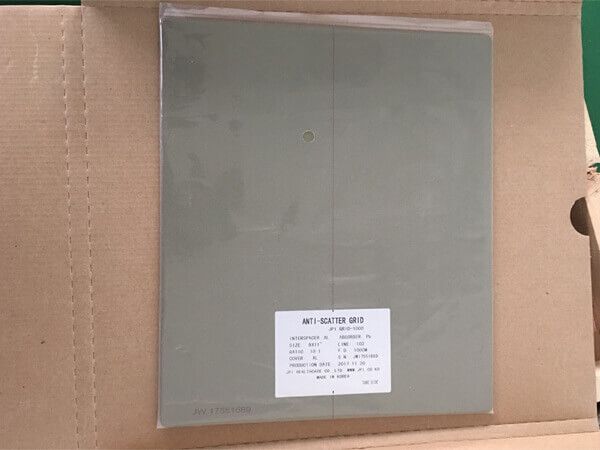
As a core auxiliary component of medical X-ray imaging equipment, the grid filter plays an irreplaceable role in improving image clarity and eliminating scattered radiation. Widely applied in hospital radiology departments, physical examination centers and industrial flaw detection scenarios, this precision device filters out disorderly scattered X-rays and only retains effective straight rays to form high-precision imaging. Long-term high-frequency operation, improper manual operation and aging loss will trigger various common faults, affecting imaging quality and even delaying clinical diagnosis. This article systematically analyzes mainstream grid filter faults, root causes and practical maintenance solutions for industry practitioners.
To understand filter grid faults, it is essential to master its basic working principle. A standard grid filter consists of dense lead strips and permeable aluminum or plastic intervals arranged alternately. When X-rays penetrate the human body or detected objects, a large number of scattered rays will be generated. The vertical lead strips block disorderly scattered rays, while the interval channels allow valid vertical X-rays to pass through smoothly. This physical filtering principle effectively reduces image fogging, improves contrast, and guarantees the accuracy of X-ray imaging results.
The most frequent fault of grid filters is blurred and foggy imaging with reduced contrast. The core cause is excessive accumulated dust, debris and radioactive residue on the grid surface and internal gaps. In long-term working environments, tiny particles will adhere to lead strips and intervals, blocking partial effective rays and failing to filter scattered rays completely. In addition, slight offset and dislocation of the grid position caused by equipment vibration will also lead to incomplete ray filtering. The targeted maintenance solution is regular professional cleaning: use dust-free soft cloth and neutral sterile solvent to wipe the grid surface, clean internal gap dust with low-pressure dust blowing equipment, and calibrate the grid installation position regularly to ensure it is parallel to the X-ray emission direction.
Stuck grid movement and abnormal mechanical jitter are also typical operational faults. Most mobile grid filters rely on transmission motors and guide rails to achieve reciprocating movement during imaging. Long-term friction causes guide rail wear, lubricating oil dry failure or motor aging load overload, resulting in unsmooth operation, jitter or stalling. If not repaired in time, it will cause grid ray leakage and regular imaging failure. The maintenance measure is to regularly check guide rail abrasion, replace dried lubricating grease with special high-temperature lubricant, test motor operating current regularly, and replace aging motors and damaged transmission parts in time to restore stable mechanical operation.
Partial ray leakage and local imaging dark spots are mainly caused by grid local deformation and lead strip damage. External extrusion, collision and long-term high-intensity radiation erosion will lead to bending, falling off or corrosion of individual lead strips, forming ray leakage gaps. For slight deformation, professional calibration and correction can be adopted; for damaged and corroded lead strips, partial replacement or overall grid renewal is required to avoid continuous imaging defects.
In general, most grid filter faults stem from daily neglect of maintenance, mechanical aging and irregular operation. Adhering to regular cleaning, position calibration and mechanical inspection can effectively reduce fault rates. Timely targeted maintenance according to fault manifestations can extend the service life of the grid filter and ensure long-term stable and high-quality operation of X-ray imaging equipment.
Post time: Aug-20-2026