
page_banner

news

Eudaimonic portable DR unlocks all scenario mobile imaging diagnosis breaking confinement of fixed radiology rooms

Traditional medical imaging diagnosis has long been plagued by a universal pain point: radiographic examinations are confined within dedicated radiology rooms. Patients have to travel to the radiology department for X-ray scans. For elderly patients with limited mobility, post-operative bedridden individuals and critically ill ICU patients, patient transfer consumes tremendous time and labor, and may trigger vital sign fluctuations, catheter dislodgement and other risks. Primary health centers, community clinics, mobile outreach physical examinations and emergency rescue operations are further restricted by site conditions and equipment limitations. Timely X-ray screening cannot be implemented, potentially missing optimal treatment windows.
The core value of medical imaging does not lie in stationary equipment, but delivering precise diagnosis to every site where care is needed. As an essential upgrade solution for medical imaging, portable Digital Radiography (portable DR) breaks spatial and scenario barriers. It enables imaging diagnosis to step out of radiology departments and reach frontline settings, setting new benchmarks for mobile medical services.

I. What Is Portable DR A Revolution In Mobile Imaging Service

Many practitioners wonder about the differences between portable DR and conventional fixed DR. Conventional fixed DR features bulky and heavy structures, requiring dedicated lead-lined radiology rooms, professional wiring and infrastructure renovation. It incurs high deployment costs and is limited to fixed locations with almost zero mobility.
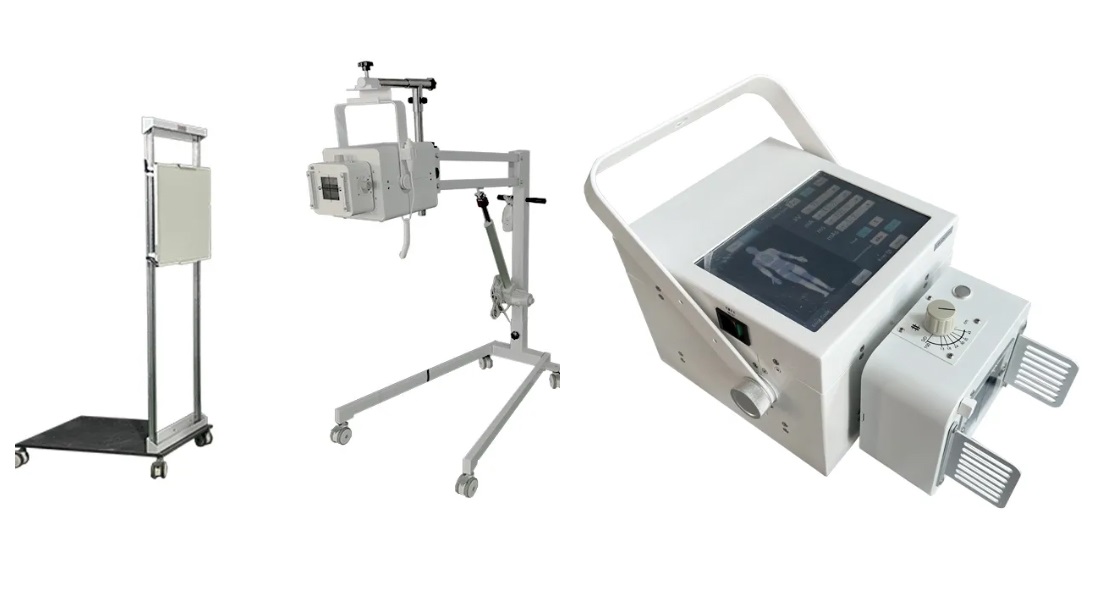
Portable DR represents a new generation of highly integrated imaging equipment. It integrates miniaturized high-frequency high-voltage generators, high-definition wireless flat-panel detectors and intelligent imaging workstations. Abandoning cumbersome traditional frameworks, the system adopts a lightweight body design supporting integrated storage and ready-to-use operation. No dedicated radiology room or complicated installation is required, completely eliminating geographical restrictions.
To put it simply: fixed DR requires patients to approach the machine, while portable DR brings diagnostic equipment directly to patients, establishing a full-function radiology unit at the bedside.

II. Four Core Advantages To Resolve Multiple Clinical Challenges

✅ Ultimate portability for seamless adaptation across diverse scenarios

The entire unit adopts a lightweight, foldable structure that can be transported and rapidly deployed by a single operator. It occupies minimal storage space after packing. Whether in hospital wards, emergency ICUs, primary care clinics, outdoor physical examination sites, rural outreach clinics or emergency rescue scenes, the device can be set up quickly to perform radiographic scanning anytime and anywhere. It perfectly meets the demand for mobile, large-scale and on-site screening programs.

✅ High-definition instant imaging to maximize clinical efficiency

Equipped with a large-format high-resolution cesium iodide flat-panel detector, the system delivers refined imaging with outstanding detail reproduction. It can accurately capture subtle lesions in the lungs, bones, thoracic cavity and other anatomical regions, furnishing reliable imaging evidence for clinical diagnosis. Images are generated within 3 seconds with instant preview available. Lengthy waiting periods are eliminated, significantly improving examination throughput. The daily screening capacity surpasses traditional equipment, making it ideal for large-scale physical screening initiatives.

✅ Low-radiation design prioritizing safety for patients and staff

Adopting next-generation high-frequency low-dose imaging technology, the system precisely controls radiation output. Radiation exposure is far lower than industry standards and conventional X-ray equipment. While preserving superior image quality, the technology minimizes radiation hazards to clinicians and patients. It is safe for seniors, children and sensitive populations, balancing diagnostic accuracy and occupational safety.

✅ Intelligent operation tailored for primary healthcare settings

The equipment features simplified workflows embedded with intelligent imaging algorithms that automatically optimize imaging parameters and perform image correction. Operators without specialized radiographer backgrounds can master operation rapidly. Wireless image transmission, cloud archiving and one-click report generation are supported, satisfying digital transformation demands of primary medical institutions. It achieves affordable procurement, simple installation and user-friendly operation.

III. Cost Reduction And Efficiency Boost To Advance High-Quality Primary Healthcare

For primary medical institutions, equipment selection centers on practicality, cost-effectiveness, efficiency and high utilization rate. Compared with large-scale conventional imaging systems, portable DR requires lower capital investment, eliminates infrastructure expenditure, features simple maintenance and lower energy consumption, greatly easing operational pressure on medical facilities. Supported by multi-scenario adaptability and frequent utilization, it avoids equipment idleness and waste, effectively expanding service capacity and revenue streams for healthcare providers.
Against the backdrop of progressive hierarchical medical systems, bridging gaps in imaging services is critical for primary facilities to retain local patients and upgrade service standards. Supported by low investment threshold and professional diagnostic capacity, portable DR empowers primary care services to build imaging capabilities from scratch and continuously improve service quality.
Moving forward, mobile medical devices will remain a core trend for primary healthcare upgrading. A high-performance portable DR serves not only as an upgrade tool for medical institutions but also as solid support to safeguard residents’ local healthcare access.

IV. Escape Homogenized Equipment Competition To Match Real-World Primary Care Demands

Many medical institutions fall into a procurement misconception: blindly pursuing large high-end equipment without evaluating actual operational scenarios and service requirements. Fixed DR installed in large hospitals suits high-volume centralized inpatient diagnosis, yet it cannot adapt to the decentralized, mobile and space-limited service model of primary healthcare.
Portable DR focuses on lightweight architecture, low total cost of ownership, wide compatibility and easy operation, precisely addressing primary care pain points. Specialized lead-shielded room renovation is unnecessary; basic radiation protection conditions support normal operation, saving massive construction expenses. The compact unit requires little clinic space and allows flexible storage and placement. Streamlined operating procedures remove reliance on full-time radiographers. Medical staff can operate the device after brief training, solving the longstanding manpower shortage challenge at grassroots facilities.
Distinct from traditional equipment characterized by heavy investment, difficult maintenance and limited applicable scenarios, portable DR truly delivers accessibility for small-scale medical organizations, ensures frequent daily operation and adapts to diversified service environments.
[Image Insert Area]

Conclusion

Advancement in medical services never equals blind investment in high-end equipment. Instead, progress relies on solutions tailored to real clinical needs to tackle tangible challenges. Contrasted with the high barriers and restrictions of large conventional imaging devices, portable DR breaks inherent stereotypes of equipment procurement. Featuring lightweight deployment, low upfront investment, cross-scenario compatibility and simple maintenance, it effectively resolves major challenges confronting primary medical facilities including limited premises, insufficient workforce, constrained budgets and narrow service coverage.
Portable DR is more than a mobile radiographic scanner. It acts as a practical tool to improve primary medical capacity, upgrade public health services and deliver convenient local medical care. It fills gaps in grassroots imaging diagnosis, enabling residents to access professional X-ray imaging services nearby without long-distance referral. Meanwhile, it helps medical institutions optimize resource allocation, expand service coverage and guarantee consistent diagnostic quality with human-centered care.
As the primary healthcare service system continues to evolve, adaptable, cost-effective mobile medical devices will stand as a preferred upgrade option for grassroots facilities. Powered by technological innovation, these devices strengthen hierarchical medical systems and consolidate frontline public health defense lines.
We devote ourselves to advancing medical imaging technology, empowering primary healthcare development. We focus on developing highly adaptable, cost-effective and safe portable medical devices to improve service efficiency at grassroots medical institutions and guarantee accessible local healthcare for all populations.
Snipaste_2026-08-04_08-25-37

Post time: Aug-04-2026