

friend reached out to me the other day. His hospital planned to replace their DR system, and manufacturers handed him piles of specification sheets. He was overwhelmed, as every parameter seemed critical and every supplier claimed their product was superior. He asked me how he should make the choice. I told him not to fixate only on spec sheets. Specification sheets only show favorable data, while real-world usage brings unexpected troubles.
The truth behind specification sheets
These figures are not meaningless, yet they are not your top priority. All test data on datasheets is acquired under ideal laboratory conditions. In actual clinical work, image quality is affected by many factors: the condition of the X-ray tube, projection angle, post-processing algorithms, technician proficiency and so on. The flat panel detector is just one part of the whole system.
Amorphous silicon vs amorphous selenium
He nodded and asked about the difference between amorphous silicon and amorphous selenium panels, since every vendor praises their own solution. Amorphous selenium panels deliver sharper images with finer details. They convert X-rays directly into electric signals without a scintillator layer. It sounds perfect, right? However, they are extremely sensitive to operating environments. Minor fluctuations in temperature or humidity can trigger faults. The selenium layer is fragile; a simple knock or drop may render it unusable, and replacement costs can start at tens of thousands of currency units.
Amorphous silicon panels add a scintillator layer that turns X-rays into visible light before electric conversion. The image appears slightly softer, yet it fully meets routine clinical diagnostic standards. More importantly, they are robust, tolerant of varying temperature and humidity, and carry much lower repair costs after impact.
Do not blindly chase maximum sharpness. First evaluate your working scenarios. Tertiary hospitals with constant-temperature and constant-humidity rooms and sufficient budgets can opt for amorphous selenium. For primary hospitals, township clinics and mobile DR applications, amorphous silicon is the practical pick.
Wired panel versus wireless panel
Then he asked about wireless panels, which are trendy now. Should he simply go wireless? I warned him not to treat wireless as an automatic upgrade. Wireless panels offer great convenience without connecting cables. They can be carried freely for bedside, emergency and orthopedic radiography. Still, there are hidden drawbacks you need to consider.
First comes the battery. Wireless panels rely on built-in batteries. Battery degradation is inevitable. After two to three years, runtime will drop noticeably, and battery replacement creates extra expense. You cannot afford power failure mid-examination.
Next is fall risk. Wired panels are mounted on tables or upright stands and rarely moved manually. Wireless panels are carried around by technicians. They may slip off hospital beds, carts or out of hands. A single fall can lead to repair bills running into thousands.
Signal stability is another concern. Wireless transmission depends on Wi-Fi. Hospital Wi-Fi can be unstable in crowded zones, corners or ICUs with heavy metal shielding. Lost transmission delays clinical work. Wired panels also have downsides: cables wear out over time and limit movement range.
For fixed radiography rooms mainly for chest and upright radiography, wired panels provide stable performance and lower running costs. For heavy bedside and emergency imaging tasks, wireless panels bring better flexibility. If budget permits, dual-panel setup, one wired and one wireless, is the ideal solution.
Total cost of ownership
He then asked about pricing, a very practical question. I told him not to compare only upfront purchase prices. This is a common pitfall. Many institutions only focus on the initial payment. Few calculate long-term expenses over five or ten years: repair fees for panel failures, on-site service charges, spare part prices and response speed.
Some units look cheap at first glance, yet their panels use proprietary technology. Repairs can only be done by the original manufacturer, and one service charge may nearly equal the cost of two generic domestic panels. When sourcing, calculate total cost of ownership. Add purchase cost, five-year maintenance, repair and spare part expenses, then divide by years of service. This calculation reveals that some seemingly low-priced options are actually costly in the long run.
After sales support matters more than parameters
He raised one last vital question: what should be prioritized when choosing a manufacturer? Always confirm whether local service outlets are available, engineer response time, stock of common spare parts, warranty length and out-of-warranty pricing. Domestic manufacturers often hold advantages here. Their service networks cover grassroots locations and offer fast response. Many overseas brands only station engineers in major cities, and on-site support may take one or two extra days of travel. For primary hospitals, reliable after-sales service outweighs brand reputation.
Newheek self manufactured flat panel detectors
We manufacture flat panel detectors in-house and supply amorphous silicon wired panels matched with our own DR systems. We fully understand the imaging performance of our matched sets. Do not judge quality purely by specification figures. Review real radiographs. Our lumbar images clearly show vertebral edges, intervertebral spaces and bony details required for diagnosis, which satisfy routine clinical needs. The supporting workstation software is intuitive, requiring minimal training for technicians.
Our pricing is straightforward as direct manufacturer supply removes middleman markup. Local engineers provide same-day response with readily available spare parts, avoiding long waits for cross-region shipments.
He said he would schedule a site visit later. I invited him to bring existing films for side-by-side on-site imaging comparison, which is far more revealing than reading dozens of datasheets.
At the end of the day, flat panel detectors are not better just because they are pricier or carry higher parameters. The best choice is the one that fits your hospital’s actual workflow.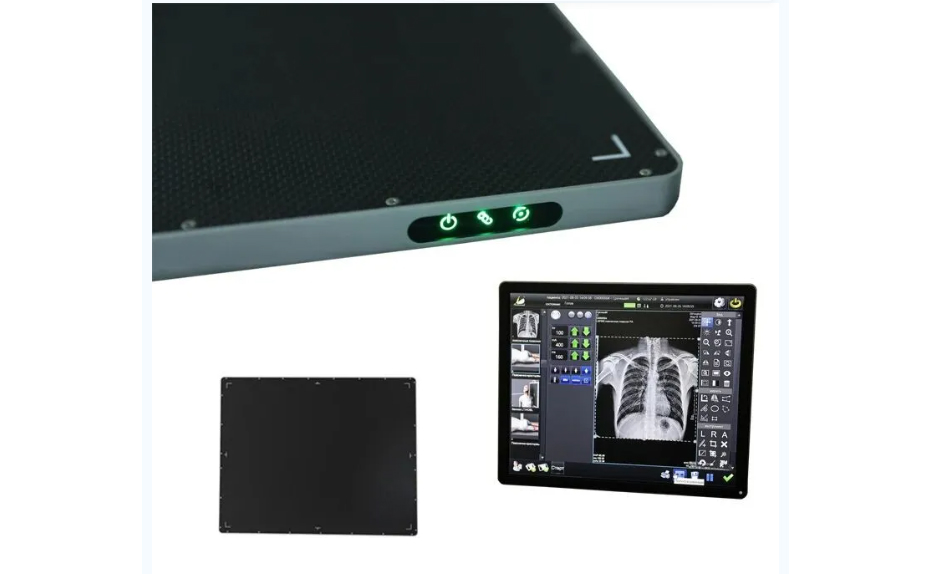
Post time: Nov-06-2026