

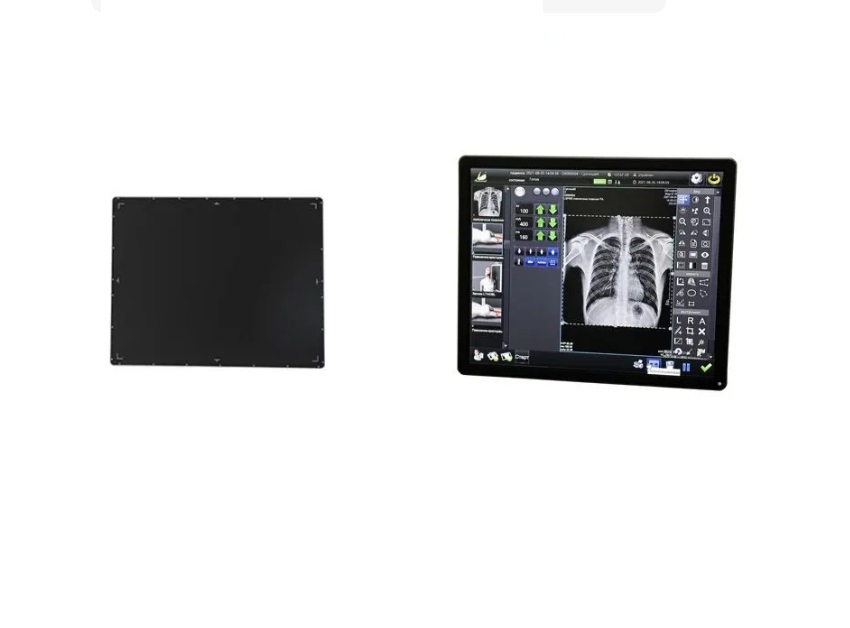
Mobile Digital Radiography (Mobile DR) has become an indispensable diagnostic device in modern clinical medicine, widely used in emergency treatment, ward bedside examination, and field medical rescue. As the core imaging component of mobile DR, the flat panel detector directly determines the clarity, accuracy and diagnostic value of X-ray images. In actual clinical operation, image noise is one of the most common problems plaguing imaging quality. Excessive noise will blur lesion details, reduce image signal-to-noise ratio (SNR), and even lead to misdiagnosis and missed diagnosis. Therefore, analyzing the noise causes of mobile DR flat panel detectors and exploring practical optimization schemes is crucial for standardizing equipment operation and improving medical imaging quality.
To understand detector noise, it is necessary to clarify its basic working principle first. The flat panel detector of mobile DR mainly adopts indirect conversion imaging technology. When X-rays penetrate the human body and reach the detector surface, the scintillation layer converts invisible X-ray photons into visible light signals. Subsequently, the photodiode array converts optical signals into analog electrical signals, which are then collected, amplified and converted into digital signals by the backend circuit system. Finally, the software reconstructs digital signals into complete X-ray images. The whole process involves photoelectric conversion, circuit transmission and digital processing, and any link abnormality will generate noise interference.
The noise of mobile DR flat panel detectors mainly comes from three core sources: inherent device noise, environmental interference noise and operational noise. Inherent noise is the intrinsic defect of hardware components, including dark current noise and readout noise. Dark current noise is generated by the thermal excitation of photodiodes. Even without X-ray irradiation, temperature changes will cause tiny current fluctuations, forming uniform background noise on images. Readout noise derives from circuit amplification and signal transmission errors, which are unavoidable during data acquisition.
Environmental noise is a unique interference factor for mobile DR, different from fixed DR equipment. Mobile devices often work in complex ward and emergency environments, with unstable power voltage, electromagnetic interference from ward equipment such as monitors and defibrillators, and ground wire interference. These external interferences will distort electrical signals and form irregular stripe noise and spot noise on images. In addition, inconsistent ambient temperature and humidity will also affect the working stability of the detector photosensitive elements and aggravate noise generation.
Operational noise is closely related to clinical operating specifications and is the main controllable noise source. Excessively low X-ray exposure parameters will lead to insufficient signal photon number, resulting in serious quantum noise, which is the most common cause of fuzzy bedside imaging. Meanwhile, improper placement of the detector, long service time leading to component aging, and uncalibrated equipment will also increase image noise and reduce imaging consistency.
Combined with industry maintenance standards and clinical practical experience, targeted optimization schemes can effectively suppress detector noise. First, complete regular equipment calibration, including dark field calibration and gain calibration, to eliminate inherent dark current noise and correct signal deviation. Second, standardize operating parameters, select appropriate tube voltage and current according to the patient’s body thickness, and avoid low-dose exposure blindly to reduce quantum noise.
In terms of environmental optimization, stabilize the equipment power supply, use independent power sockets for mobile DR, and keep a safe distance from electromagnetic equipment to avoid signal interference. Daily equipment maintenance is also essential; regularly clean the detector surface, check circuit aging and wiring looseness, and replace aging accessories in time. In addition, controlling the working environment temperature and humidity within the industry-specified range can effectively maintain the stable performance of photoelectric components.
In conclusion, the noise of mobile DR flat panel detectors is affected by hardware, environment and operation. Systematic noise suppression through standardized operation, regular maintenance and environmental optimization can significantly improve image SNR and imaging quality. This not only meets clinical high-precision diagnostic needs but also extends the service life of mobile DR equipment, which has important practical value for medical imaging quality control and equipment management.
To understand detector noise, it is necessary to clarify its basic working principle first. The flat panel detector of mobile DR mainly adopts indirect conversion imaging technology. When X-rays penetrate the human body and reach the detector surface, the scintillation layer converts invisible X-ray photons into visible light signals. Subsequently, the photodiode array converts optical signals into analog electrical signals, which are then collected, amplified and converted into digital signals by the backend circuit system. Finally, the software reconstructs digital signals into complete X-ray images. The whole process involves photoelectric conversion, circuit transmission and digital processing, and any link abnormality will generate noise interference.
The noise of mobile DR flat panel detectors mainly comes from three core sources: inherent device noise, environmental interference noise and operational noise. Inherent noise is the intrinsic defect of hardware components, including dark current noise and readout noise. Dark current noise is generated by the thermal excitation of photodiodes. Even without X-ray irradiation, temperature changes will cause tiny current fluctuations, forming uniform background noise on images. Readout noise derives from circuit amplification and signal transmission errors, which are unavoidable during data acquisition.
Environmental noise is a unique interference factor for mobile DR, different from fixed DR equipment. Mobile devices often work in complex ward and emergency environments, with unstable power voltage, electromagnetic interference from ward equipment such as monitors and defibrillators, and ground wire interference. These external interferences will distort electrical signals and form irregular stripe noise and spot noise on images. In addition, inconsistent ambient temperature and humidity will also affect the working stability of the detector photosensitive elements and aggravate noise generation.
Operational noise is closely related to clinical operating specifications and is the main controllable noise source. Excessively low X-ray exposure parameters will lead to insufficient signal photon number, resulting in serious quantum noise, which is the most common cause of fuzzy bedside imaging. Meanwhile, improper placement of the detector, long service time leading to component aging, and uncalibrated equipment will also increase image noise and reduce imaging consistency.
Combined with industry maintenance standards and clinical practical experience, targeted optimization schemes can effectively suppress detector noise. First, complete regular equipment calibration, including dark field calibration and gain calibration, to eliminate inherent dark current noise and correct signal deviation. Second, standardize operating parameters, select appropriate tube voltage and current according to the patient’s body thickness, and avoid low-dose exposure blindly to reduce quantum noise.
In terms of environmental optimization, stabilize the equipment power supply, use independent power sockets for mobile DR, and keep a safe distance from electromagnetic equipment to avoid signal interference. Daily equipment maintenance is also essential; regularly clean the detector surface, check circuit aging and wiring looseness, and replace aging accessories in time. In addition, controlling the working environment temperature and humidity within the industry-specified range can effectively maintain the stable performance of photoelectric components.
In conclusion, the noise of mobile DR flat panel detectors is affected by hardware, environment and operation. Systematic noise suppression through standardized operation, regular maintenance and environmental optimization can significantly improve image SNR and imaging quality. This not only meets clinical high-precision diagnostic needs but also extends the service life of mobile DR equipment, which has important practical value for medical imaging quality control and equipment management.
Post time: Jun-09-2026