

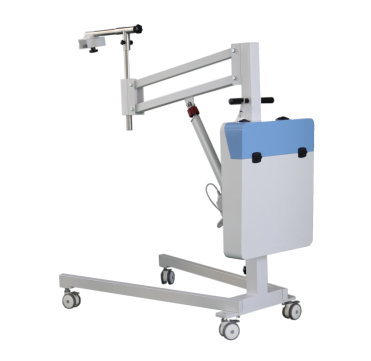
As primary and emergency medical systems continue to improve globally, flexible and efficient medical imaging equipment has become key to improving diagnostic efficiency. Among conventional radiology devices, portable X-ray machines stand out from traditional fixed X-ray equipment due to their lightweight design, flexible movement and independent power supply. They cover more diversified and high-demand medical scenarios, making them essential imaging tools in modern clinical diagnosis, grassroots medical treatment and emergency rescue work.
Portable X-ray machines share the same core working principle as fixed models, conforming to basic X-ray imaging industry principles. The equipment generates X-ray beams through an X-ray tube. These beams penetrate human tissues, and different tissues absorb X-rays at varying degrees. The flat panel detector converts residual light signals into digital data, which is processed into standard grayscale medical images for doctors to judge fractures, pulmonary infections and other lesions. Different from fixed devices relying on fixed circuits and heavy racks, portable X-ray machines adopt miniaturized integrated circuits and built-in battery modules, ensuring stable imaging quality while realizing free movement.
The biggest advantage of portable X-ray machines lies in their adaptable and inclusive medical application scenarios, solving many pain points of fixed equipment. Traditional fixed X-ray machines are limited to special radiology rooms, requiring patients to move actively for examination. This mode is not applicable to special groups such as critically ill patients, bedridden elderly patients, postoperative immobilized patients and disabled patients, who face risks of secondary injury and condition deterioration during transportation.
Portable X-ray machines realize bedside on-demand imaging, covering core hospital scenarios including inpatient ward routine screening, intensive care unit emergency inspection and postoperative real-time review. Doctors can complete radiographic examination directly beside the bed, greatly improving diagnosis efficiency and ensuring patient safety. In addition, they are perfectly suitable for grassroots medical scenarios such as community health centers, rural clinics and mobile medical vehicles, making up for the lack of radiology equipment in primary medical institutions.
They also show unique practical value in special emergency and public health scenarios. In pre-hospital rescue, accident site first aid and field medical support, portable X-ray machines can start quickly and complete imaging in real time, providing accurate imaging basis for on-site first aid. Meanwhile, modern portable X-ray machines adopt low-dose radiation optimization technology, which strictly complies with medical radiation protection standards, balancing imaging clarity and patient radiation safety.
In conclusion, portable X-ray machines break the spatial and environmental restrictions of fixed radiology equipment. With flexible and comprehensive medical application scenarios, they cover hospital inpatient examination, grassroots medical services and emergency rescue, effectively optimizing medical diagnosis processes. They have become an indispensable core device in modern graded medical treatment systems, with prominent clinical practicability and popularization value.
Portable X-ray machines share the same core working principle as fixed models, conforming to basic X-ray imaging industry principles. The equipment generates X-ray beams through an X-ray tube. These beams penetrate human tissues, and different tissues absorb X-rays at varying degrees. The flat panel detector converts residual light signals into digital data, which is processed into standard grayscale medical images for doctors to judge fractures, pulmonary infections and other lesions. Different from fixed devices relying on fixed circuits and heavy racks, portable X-ray machines adopt miniaturized integrated circuits and built-in battery modules, ensuring stable imaging quality while realizing free movement.
The biggest advantage of portable X-ray machines lies in their adaptable and inclusive medical application scenarios, solving many pain points of fixed equipment. Traditional fixed X-ray machines are limited to special radiology rooms, requiring patients to move actively for examination. This mode is not applicable to special groups such as critically ill patients, bedridden elderly patients, postoperative immobilized patients and disabled patients, who face risks of secondary injury and condition deterioration during transportation.
Portable X-ray machines realize bedside on-demand imaging, covering core hospital scenarios including inpatient ward routine screening, intensive care unit emergency inspection and postoperative real-time review. Doctors can complete radiographic examination directly beside the bed, greatly improving diagnosis efficiency and ensuring patient safety. In addition, they are perfectly suitable for grassroots medical scenarios such as community health centers, rural clinics and mobile medical vehicles, making up for the lack of radiology equipment in primary medical institutions.
They also show unique practical value in special emergency and public health scenarios. In pre-hospital rescue, accident site first aid and field medical support, portable X-ray machines can start quickly and complete imaging in real time, providing accurate imaging basis for on-site first aid. Meanwhile, modern portable X-ray machines adopt low-dose radiation optimization technology, which strictly complies with medical radiation protection standards, balancing imaging clarity and patient radiation safety.
In conclusion, portable X-ray machines break the spatial and environmental restrictions of fixed radiology equipment. With flexible and comprehensive medical application scenarios, they cover hospital inpatient examination, grassroots medical services and emergency rescue, effectively optimizing medical diagnosis processes. They have become an indispensable core device in modern graded medical treatment systems, with prominent clinical practicability and popularization value.
Post time: Jun-10-2026